Off-Grid Solar Design in Australia: Getting Panel Orientation and Battery Ratio Right
Garry Williams · Founder, Empowered Offgrid
When you’re off-grid, every design decision comes back to one principle: your solar panels are the cheap part of the system, so you want them doing as much of the work as possible. If the panels aren’t carrying your loads, your batteries are. If the batteries run flat, the generator takes over — and then you’re paying for your power.
Two of the decisions that make the biggest difference to how hard your panels work are which way they face and how your array is sized against your battery bank. Here’s how we think about both at Empowered Offgrid.
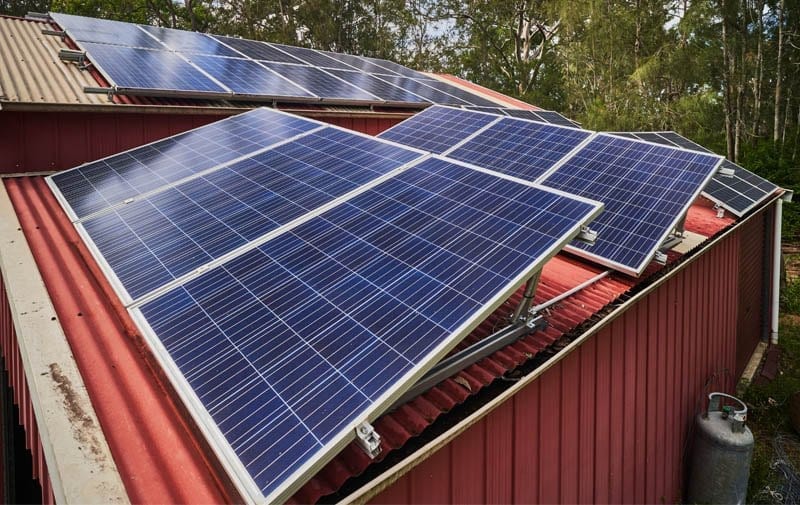
How to Orient Solar Panels for Year-Round Off-Grid Power
The goal with orientation is generation from sun-up to sun-down, and strong generation right through the seasons. Get this right, and the panels carry your loads for more of the day, every day of the year.
Why winter is the “pointy end”
Winter is where off-grid systems get tested. The days are short and the weather isn’t always on your side, so a system that looks great in January can struggle in July. That’s why we design around winter first — if it performs in winter, summer looks after itself.
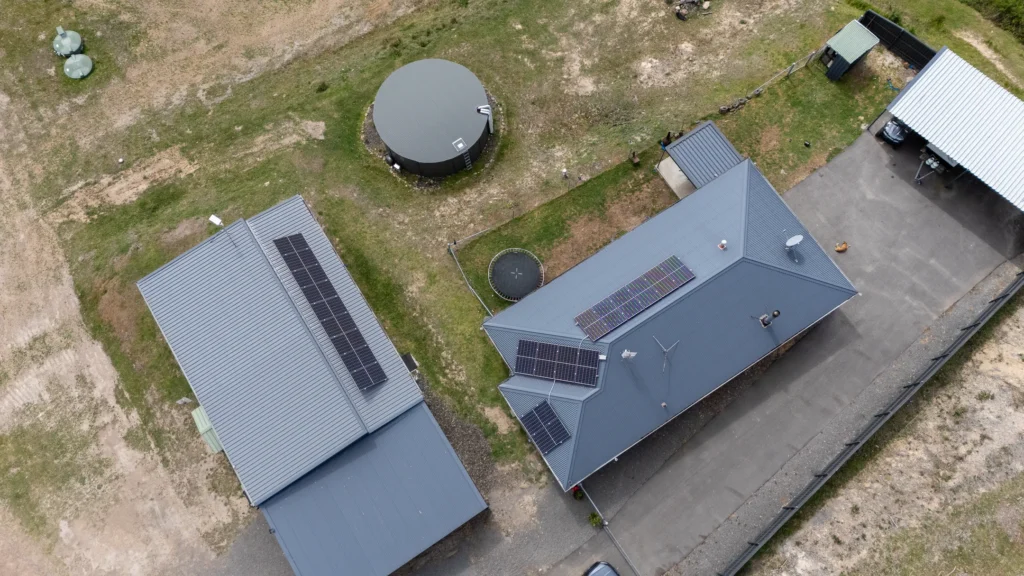
North-east / north-west at 30° — the all-season setup
For most off-grid sites, our preferred orientation is north-east and north-west facing panels, tilted at around 30 degrees. It’s the best all-rounder across the seasons. It works hard in winter, because the sun rises in the north-east and sets in the north-west — so you capture the morning and afternoon sun when you most need it. It also gives a good spread in summer, when the sun rises in the south-east and sets in the south-west. (Off-grid panels in Australia face north — the opposite of northern-hemisphere advice you’ll see online.)
The east-west-and-north alternative
The other option we use is a combination of east-west and north-facing panels: east-west for about nine months of the year, and north to cover winter.
Matching Your Solar Array to Your Battery Bank
Once orientation is sorted, the next question is how much battery storage to pair with your array. A common assumption is “more battery is always better.” It isn’t.
Why bigger isn’t always better
Batteries stay healthiest when they’re charged regularly. If you oversize the battery bank relative to the array, you may not fully charge it several times a week — and a battery that rarely gets a full charge can’t balance all its cells properly. Over time, that’s damaging. In winter, with less solar coming in, an oversized bank is at real risk of never getting charged.
The 3:1 rule of thumb
As a starting point, we look at roughly a three-to-one ratio of storage to solar. So if you’ve got 10 kilowatts of solar, you’re looking at around 30 kilowatt hours of batteries. Go much bigger than that, and you risk under-charging the bank in winter. It’s a guide, not a law.
Talk to the team at Empowered Offgrid
Every site is different, and the right orientation and battery sizing depend on your loads, your location and your roof.
Get an off-grid system designed for your site
About the author
Garry Williams founded Empowered Offgrid’s predecessor, Solar Service Centre, in 1991 and has designed off-grid power systems ever since. He lived off-grid at Wootton, NSW for twenty-three years and has more than two hundred off-grid installations behind him.